Small steps. Weekly demos. No surprises.
Twenty years of delivery have taught me that most software risk is communication risk. My process is built to keep you informed, in control and seeing real progress every week.
The four stages of a project
Discover
We talk about the problem, not the technology. I'll ask awkward questions, map the constraints and tell you honestly if I'm not the right fit.
Prototype
A thin, working slice on your real data. It's the quickest way to de-risk an idea and get stakeholders excited, or save you from a bad investment.
Build & integrate
Prioritised backlog, short sprints and a demo every week. You can change direction at any sprint boundary.
Run & improve
Production monitoring, support and improvements on retainer, or a documented hand-over with knowledge-transfer sessions.
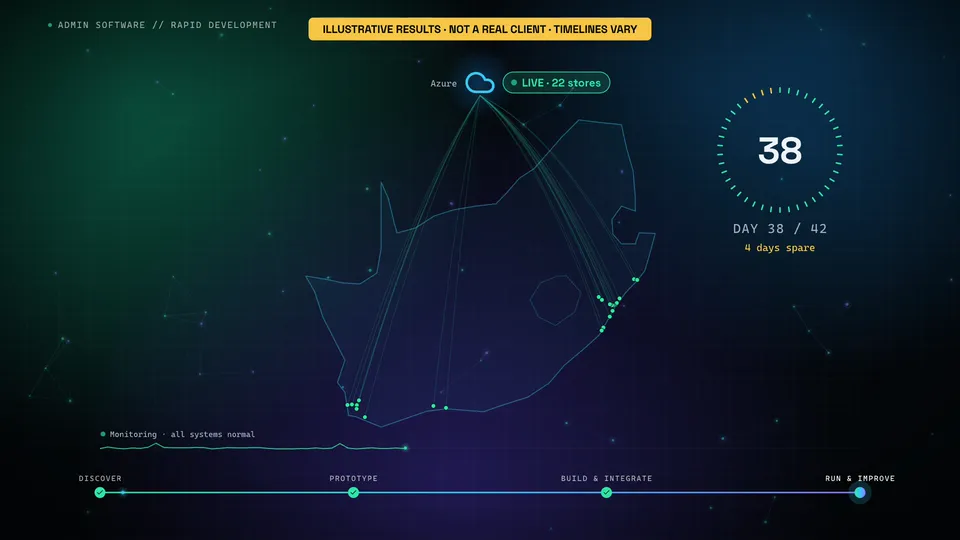
Watch a project run, start to finish.
Follow one illustrative project through discovery, a prototype on real data, weekly sprints, tested AI and go-live, against a hard Black Friday deadline.
What's your deadline?
Illustrative scenario: Kransveld Outdoor is a fictional retailer and every figure is an example. Real timelines depend on scope.
What you can always expect.
These aren't slogans. They're the habits that make a one-person company a safe pair of hands.
Radical transparency
Shared board, weekly written updates and time reports. You always know where things stand.
Yours from day one
Code in your repo, infrastructure in your cloud account, docs in your wiki. No lock-in.
Outcomes over output
We agree what success looks like up front, and measure it, especially for AI.
Honest advice
If something shouldn't be built, or AI isn't the answer, I'll say so before you spend money.
Two weeks from idea to evidence.
A typical AI prototype sprint. The aim is a working demo and hard numbers to decide on.
- Days 1–2
Frame the problem
Pick one high-value use case, collect 30–100 real examples and agree what a "good answer" looks like.
- Days 3–5
Connect the data
Ingest the relevant documents or systems, with PII handling agreed and applied before anything touches a model.
- Days 6–8
Build the slice
Retrieval, prompts, tools and a simple UI, embedded where users already work, such as a web app, Teams or email.
- Days 9–10
Measure & decide
Run the evaluation set, compare models and costs, then present results with a clear go / tweak / stop recommendation.
- Then
Production roadmap
If it's a go: a plan to harden, secure, monitor and roll out, with a realistic budget and timeline.
What you walk away with.
Clean source code
Reviewed, tested and in your repository with a readable history.
Infrastructure as code
Environments you can recreate with a single pipeline run.
Living documentation
Architecture decisions, runbooks and onboarding notes.
Dashboards & alerts
Health, usage and, for AI, quality and cost metrics.
Security baseline
Secrets management, least-privilege access and audit logs.
Knowledge transfer
Walk-throughs so your team can confidently own it.
Have a project that needs a senior pair of hands?
Tell me what you're trying to achieve. Within one business day you'll get an honest view of whether, and how, I can help.
No sales team, no hand-offs. You'll speak directly to the engineer who builds it.
It's in South Africa · replies within one business day